
Chain Block vs Hoist vs Winch: How to Choose the Right Equipment for the Job

If you are comparing chain block vs hoist vs winch, you are usually making a real buying or specification decision, not just browsing. The right choice affects safety, productivity, operator effort and how smoothly the job runs. The problem is that these terms are often used loosely, even though they describe different types of equipment.
At Peter Cassidy Leeds Ltd, we help customers match lifting equipment to the application rather than guessing from product names alone. From our base on Holbeck Lane, Leeds, LS11 9XA, we supply and install lifting equipment, offer free initial consultations and free surveys, and support ongoing inspections and repairs. This guide explains where chain blocks, hoists and winches differ, when each one is normally the right fit and what to check before you commit.
Chain block vs hoist vs winch: what is the difference?
What is a chain block?
A chain block is a manual lifting device, sometimes called a manual chain hoist. The operator pulls a hand chain, which drives gears and raises or lowers the load on a separate load chain.
Chain blocks are designed for controlled vertical lifting. They are commonly chosen when lifts are occasional, power is not available or the job needs a simple, robust solution.
Manual operation
Best suited to vertical lifting
Good for slower, precise lifts
Often useful on site, in workshops and for maintenance work
What is a hoist?
Hoist is the wider category. A hoist can be manual or powered, and it is designed to raise and lower loads. In everyday conversation, people often use the word to mean an electric chain hoist or wire rope hoist.
If a job involves frequent lifting, faster cycle times or reduced operator effort, a powered hoist is often the better option. Hoists may be fixed in place or mounted to travel on a beam or track, depending on the application.
Broad category that includes chain blocks
Manual or electric operation
Suitable for repeated lifting tasks
Often used where productivity and consistent control matter
What is a winch?
A winch pulls or positions a load by winding rope or cable onto a drum. In many applications, the movement is horizontal or on an incline rather than straight up and down.
This is an important difference. Not every winch is designed or rated for lifting suspended loads. If the job involves lifting and holding a load overhead, the equipment must be specified for that purpose rather than assumed to be interchangeable.
Typically used for pulling, recovering, positioning or tensioning
Can suit longer travel distances
Common in industrial, site and specialist movement applications
Must be selected carefully if any lifting element is involved
Start with the movement the job actually needs
The quickest way to narrow down the choice is to forget the label for a moment and focus on the load path.
If the load must be lifted vertically
A chain block or another type of hoist is usually the right starting point. These are built around controlled lifting and lowering.
If the load must be moved often and quickly
A powered hoist normally makes more sense than a manual chain block. It can improve speed, reduce operator fatigue and support more consistent handling in a busy working environment.
If the load needs pulling, drawing in or positioning
A winch may be the better answer, especially where the load is moving across distance or along an incline. The key is to specify it for the real task, not the task you hope it will do.
How to choose the right equipment for the job
1. Look at the load, not just the headline capacity
Capacity is critical, but it is only one part of the decision. You also need to consider the load shape, centre of gravity, pick-up points and how stable the load will be while moving.
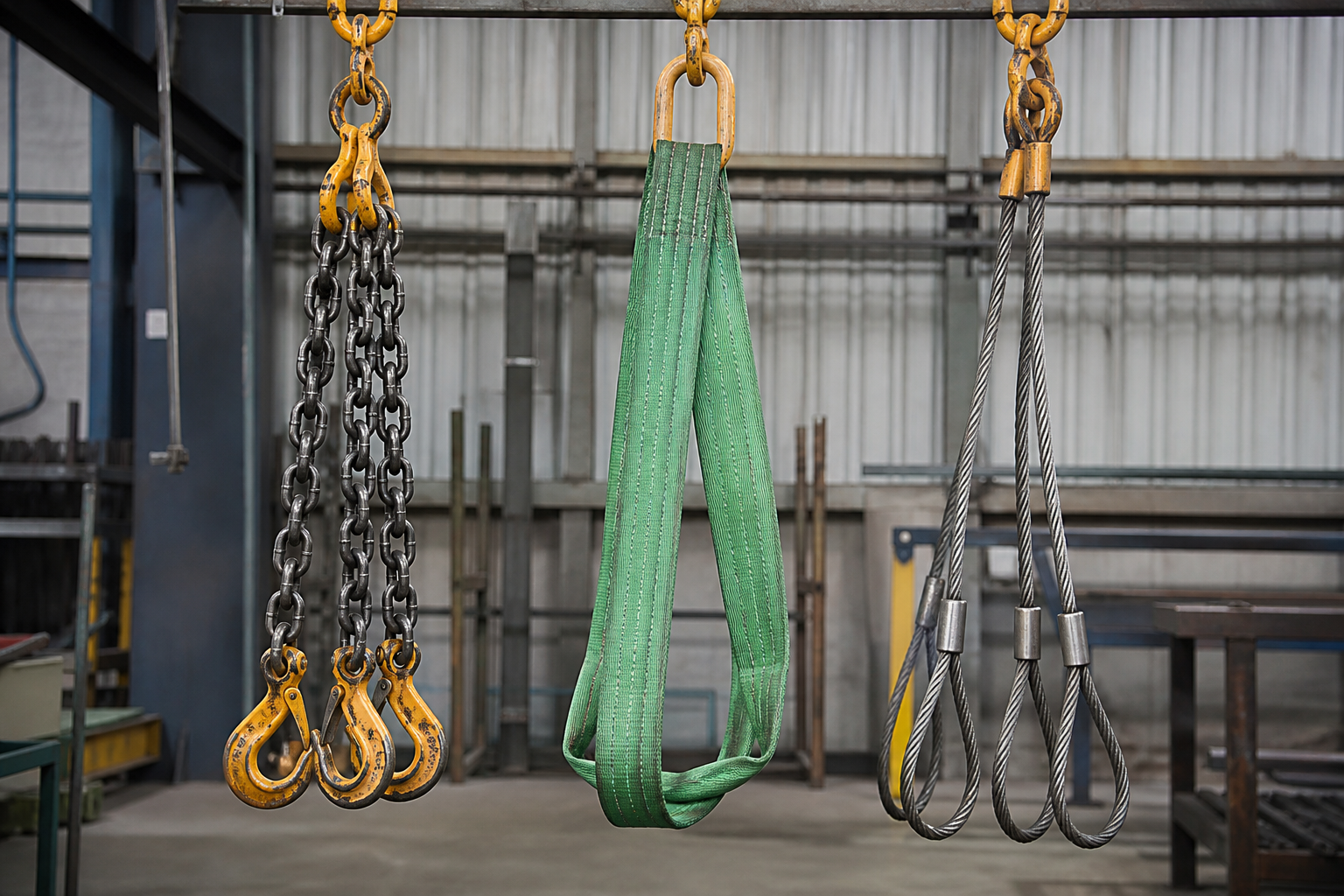
The right setup often depends on the full lifting system, not one item in isolation. We can advise on lifting hoists, lifting chains, shackles and steel wire rope so the equipment works together properly.
2. Check the direction and distance of travel
Ask whether the load is going straight up, across a workshop, along a beam or up an incline. Then check the lift height or pulling distance required. A short occasional lift and a long repeated movement can point to very different solutions.
3. Consider how often the equipment will be used
For occasional maintenance lifts, a manual chain block can be practical and economical. For regular production use, repetitive handling or higher throughput, a powered hoist is often more suitable.
This is where many buying mistakes happen. Equipment that is technically capable of the load may still be the wrong choice if it is too slow, too labour-intensive or not matched to the duty level.
4. Review the site, mounting and power supply
Will the equipment hang from an existing beam? Does the structure have enough headroom? Is there an available power supply for an electric hoist? Will the equipment need to travel or remain fixed in one position?
These practical details affect what can be installed safely and what will work day to day without causing frustration on site.
5. Think about the environment
Indoor workshops, fabrication areas, outdoor sites and harsher industrial settings can all place different demands on lifting equipment. Dirt, moisture, corrosion risk and general working conditions should all be considered before equipment is specified.
6. Plan for inspection, maintenance and long-term reliability
Choosing the right equipment is not only about day one. It is also about how the unit will be checked, maintained and kept reliable over time. If the application is safety-critical or heavily used, aftercare matters just as much as the initial purchase.
When each option is often the right fit
A chain block is often the right choice when
The lift is vertical and relatively infrequent
Manual operation is acceptable
Fine control matters more than speed
Power is not available or not necessary
You want a straightforward, durable solution for maintenance or site work
A hoist is often the right choice when
The load needs to be lifted regularly
Faster handling will improve productivity
Operator effort needs to be reduced
The equipment will be part of a more permanent lifting arrangement
Travel on a beam or integrated handling is part of the job
A winch is often the right choice when
The job is mainly about pulling or positioning
The load must travel over a longer distance
The movement is horizontal or on an incline
A drum-based system is better suited to the application
The equipment is being specified for that exact type of movement
Common mistakes to avoid
Choosing by price alone. A cheaper unit can become expensive if it slows the job down or does not suit the application.
Assuming a winch and a hoist do the same thing. They do not, and that misunderstanding can create safety and performance problems.
Ignoring headroom and mounting constraints. Even the right product on paper can be wrong on site.
Focusing only on capacity. Travel, duty, control and environment matter too.
Leaving support and servicing as an afterthought. Ongoing inspections and repairs help protect reliability and compliance.
Why businesses ask Peter Cassidy Leeds Ltd to help specify lifting equipment
When equipment is wrongly specified, the result is usually lost time, awkward handling or unnecessary risk. Our job is to make the decision clearer. We ask the practical questions, review the application and recommend equipment that fits the work you actually need to do.
Peter Cassidy Leeds Ltd has been based in Leeds since 1962. We are certified to ISO 9001:2015, ISO 14001:2015 and ISO 45001:2018, and we are active members of the Lifting Equipment Engineers Association. That combination of experience, standards and practical product knowledge is why customers come to us for supply, install and advice.
If you would like to speak to a local team, you can find our Leeds lifting equipment specialists on Holbeck Lane, LS11 9XA.
Need help choosing between a chain block, hoist and winch?
If you are still weighing up the options, the next step is simple. Let us review the application properly. We offer a free initial consultation and free survey to help identify the right chain block, hoist or winch for the job.
Tell us the load, the movement required, the frequency of use and the site conditions, and we can guide you towards a more suitable solution. To get started, book a free initial consultation or free survey with Peter Cassidy Leeds Ltd.
Frequently asked questions
Is a chain block the same as a hoist?
A chain block is a type of hoist. More specifically, it is a manual hoist designed for lifting and lowering loads using a hand chain and load chain. The word hoist is broader and can also include electric chain hoists and wire rope hoists.
Can a winch be used for lifting?
Some winches are designed for specific lifting applications, but many are mainly intended for pulling or positioning loads. That is why specification matters. If the load will be suspended, the equipment must be chosen for that duty rather than assumed to be suitable.
Should I choose a manual chain block or an electric hoist?
That depends on how often the equipment will be used, how fast the job needs to be done, whether power is available and how much operator effort is acceptable. Manual chain blocks often suit occasional lifts. Electric hoists often suit regular or repetitive lifting.
What information do you need to recommend the right equipment?
We normally need the load weight, the direction of movement, the lift height or pulling distance, how frequently the equipment will be used, the site environment, the mounting arrangement and any headroom or access restrictions. The clearer the brief, the more accurately the equipment can be specified.
Conclusion
The answer to chain block vs hoist vs winch comes down to the job itself. If you need vertical lifting, start with hoists. If you need a simple manual lifting solution, a chain block may be ideal. If the task is mainly pulling or positioning, a winch may be the better fit.
Getting that decision right at the start can save time, reduce risk and improve day-to-day efficiency. If you want experienced advice from a Leeds lifting equipment specialist, Peter Cassidy Leeds Ltd is ready to help.

Comments